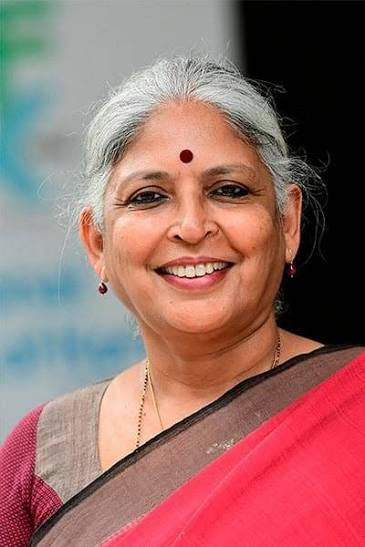
Bina Paul
The First Chair of the Society of Indian Screen Editors
There are moments in the history of an institution when a choice becomes more than a choice.
It becomes a statement.
When the Society of Indian Screen Editors began to take shape as a national professional institution, the question of its first Chair was therefore not simply a matter of filling an office.
It was a question of what kind of institution SISE wished to become.
The first Chair would have to carry more than a title.
She would have to carry a vision.
She would have to understand the craft deeply, but also understand the larger world of cinema around it. She would need the authority of experience without allowing authority to become hierarchy. She would need to understand editors not only as professionals, but as artists, teachers, collaborators and custodians of a body of knowledge.
For that first responsibility, SISE turned to Bina Paul.
And with that decision, a significant chapter in the history of Indian screen editing began.
A Life in the Cut
Bina Paul came to editing through a serious engagement with cinema and formal training at the Film and Television Institute of India, Pune, where she completed her editing training in 1983 after graduating from the University of Delhi.
Her professional journey began in the 1980s, and among her early landmark works was John Abraham's Amma Ariyan. She subsequently worked with filmmakers including G. Aravindan, P. N. Menon, Shyamaprasad, Revathi and Pamela Rooks.
Her career is remarkable not simply because of its length, but because of the range of cinema through which it has moved.
Documentary.
Independent cinema.
Feature films.
Experimental and formally ambitious work.
Film education.
Festival culture.
Public discussion about cinema.
She has worked in the cutting room, but her contribution to Indian cinema has never been confined to it.
That breadth would become important to SISE.
Because SISE was never intended to be only an organisation of editors.
It was conceived as an institution through which the art, craft, history and professional identity of editing could enter a larger conversation.
An Editor Who Became a National Presence
Bina Paul's achievements as an editor speak for themselves.
She received the National Film Award for Best Editing for Mitr, My Friend. The official Directorate of Film Festivals citation praised the film's crisp, taut editing and its imaginative treatment of the material.
She subsequently received another National Film Award for editing the non-feature film Unni.
Her work has also been recognised through Kerala State Film Awards, including awards for Daya, Sayahnam and Bioscope.
But awards alone do not explain why she became the first Chair.
What matters is the larger trajectory of her career.
She did not remain within the boundaries of a cutting room.
She moved outward into the life of cinema itself.
She became involved in film education.
She worked with documentary filmmaking.
She served as a curator and festival leader.
She participated in international film juries.
And she helped create spaces in which cinema could be discussed, encountered and understood.
The Asia Pacific Screen Awards describes her as an editor with more than three decades of work, with major credits including Amma Ariyan, Agnisakshi, Janmadinam, Mitr, My Friend, Dance Like a Man, In Othello and Daya. It also records her work as a documentary director and her long association with the International Film Festival of Kerala.
That was the kind of experience SISE needed at its beginning.
The Woman Who Helped Build a Festival Culture
One of the most significant chapters of Bina Paul's professional life has been her association with the International Film Festival of Kerala.
She was involved in the festival's creation and subsequently served as its Artistic Director for many years. The Asia Pacific Screen Awards describes her as having been involved in the creation of IFFK and as having served as Artistic Director for more than twenty years.
This achievement matters profoundly when we consider her role in SISE.
A film editor who helped shape films was also helping shape the environment in which films were seen, discussed and remembered.
She understood that cinema does not survive only through production.
It survives through culture.
Through festivals.
Through education.
Through archives.
Through conversations.
Through audiences.
Through institutions.
That understanding closely resonates with the purpose SISE would later articulate for itself: advancing editing through education, mentorship, research, publications, preservation, professional development and public awareness.
From Editing Films to Building Institutions
Perhaps this is the most important reason Bina Paul was the right person to become SISE's first Chair.
She understood both sides of the profession.
She understood the intimate world of the edit suite—the silence, concentration and accumulation of decisions through which a film takes shape.
But she also understood the public life of cinema.
She understood festivals.
She understood education.
She understood institutions.
She understood how communities around cinema are built.
And she understood that the future of a creative profession depends upon more than the excellence of individual practitioners.
It depends upon whether those practitioners are able to build institutions that preserve knowledge and create opportunities for the next generation.
That understanding was essential to the founding ambition of SISE.
Why Her Selection Was Historic
The selection of Bina Paul as the first Chair of SISE carries a significance beyond the distinction of being first.
She became the first woman to occupy the Chair of the national professional institution being created for India's screen editors.
That fact matters.
Not because SISE exists to make a symbolic appointment.
But because the person chosen to establish the tone of the institution represented an extraordinary combination of editorial excellence, institutional experience, cultural leadership and a long engagement with the future of cinema.
Her selection demonstrated something about the organisation SISE wanted to become.
It said that leadership in editing was not defined by gender.
It was not defined by region.
It was not defined by language.
It was not defined by commercial visibility.
It was defined by experience, contribution, credibility and a commitment to the craft.
And the first Chair embodied that principle.
The First Chair and the Idea of Equality
There is an important connection between Bina Paul's historic selection and the democratic philosophy that later became central to SISE's governance.
The Foundation's constitutional framework is built around:
One Member • One Vote • Equal Representation
It seeks to create an institution where professional excellence and democratic equality can coexist, and where experienced professionals and emerging leaders can contribute to its future.
The first Chair therefore represented more than the beginning of a leadership structure.
She represented the possibility of a profession organising itself around a broader understanding of leadership—one based on service to the craft rather than ownership of it.
A Chair for the Profession
The responsibility of a first Chair is unlike that of any Chair who follows.
There is no institutional tradition to inherit.
No established culture.
No long line of previous office-bearers.
No certainty about what the organisation will become.
The first Chair stands at the threshold.
Behind her is the idea.
Ahead of her is the institution.
And between them is the difficult work of making the two meet.
Bina Paul's presence at that moment gave SISE something invaluable: the authority of an editor who had already spent decades demonstrating what the profession could mean.
She came to SISE not simply as an accomplished practitioner, but as someone who had already contributed to the larger cultural life of Indian cinema.
The Meaning of Her Career
There is also something particularly appropriate about an editor becoming the first Chair.
An editor knows that no single frame contains the whole story.
Meaning emerges through relationships.
One image changes the meaning of another.
A moment gains significance because of what came before it and what follows.
Institutions are much the same.
No founder stands alone.
No Chair stands alone.
No generation stands alone.
Every generation inherits material from the one before it and leaves material for the one that follows.
Bina Paul's career itself embodies this idea.
She inherited traditions of Indian cinema.
She worked with filmmakers of different generations.
She shaped films that became part of that history.
She contributed to institutions that helped audiences encounter cinema.
And, in becoming SISE's first Chair, she became part of the effort to create an institution through which the next generation of editors could inherit something more organised, more visible and more enduring.
A Legacy Beyond Awards
Her National Awards are part of the record.
Her State Awards are part of the record.
Her films are part of the record.
Her work in festival culture is part of the record.
Her educational and institutional contributions are part of the record.
But perhaps the deeper legacy is the example of a professional who refused to see editing as a narrow occupation.
She demonstrated that an editor can become:
an artist,
an educator,
a curator,
a mentor,
an institutional leader,
and a voice for cinema.
That expanded understanding of the editor is deeply aligned with SISE's own vision of strengthening the identity of the screen editor as both artist and storyteller.
The First Chair
When history records the early years of SISE, Bina Paul's name should therefore not appear merely as the first name in a list of office-bearers.
She should be remembered at the beginning of the story because her selection expressed something fundamental about the institution.
SISE chose an editor whose career had already crossed the boundaries between craft and culture, editing and education, filmmaking and institution-building.
She was entrusted with the Chair at the moment when the idea of a national community for Indian screen editors was becoming an institution.
And in that moment, the profession made a statement about itself.
It chose a woman.
It chose an editor.
It chose an educator.
It chose an institution-builder.
It chose someone whose career had already demonstrated that the editor's place in cinema could extend far beyond the cutting room.
A Letter That Begins a Tradition
A Chair's letter is traditionally a message to the membership.
But the first Chair's letter has another responsibility.
It speaks to people who are not yet members.
To young editors who have not yet entered the profession.
To students sitting in editing rooms for the first time.
To editors working in languages and regions far from the centres of the industry.
To those whose names may one day appear in the credits of films that define another generation.
And to those who will one day inherit SISE itself.
The first Chair stands at the beginning of that conversation.
Her presence says:
You belong here.
Your craft matters.
Your voice matters.
Your experience matters.
And the profession you are entering deserves an institution of its own.
The Chair Who Came First
The history of SISE will continue to be written by generations of editors.
There will be other Chairs.
Other Councils.
Other members.
Other debates.
Other visions.
The organisation will change, because the profession will change.
But the first Chair will always occupy a place that cannot be repeated.
She was there when the institution had to take its first breath.
She stood at the beginning.
And the significance of Bina Paul as the first Chair of SISE will therefore remain part of the organisation's institutional memory—not simply because she was first, but because the first choice told the profession what kind of institution SISE intended to be.
An institution that recognises excellence.
An institution that values experience.
An institution that welcomes leadership from every generation.
An institution that understands cinema as culture.
And an institution that believes the editor belongs at the centre of the conversation about filmmaking.
To the First Chair
Bina Paul came to the Chair with a lifetime of cinema behind her.
She leaves behind more than awards and credits.
She leaves an example.
An example of what an editor can become when the boundaries of the cutting room are opened to education, culture, institution-building and service.
And so, as SISE begins its own institutional history, it is fitting that its first chapter of leadership begins with an editor whose own career has already been a history of crossing boundaries.
From the edit suite to the festival.
From the film to the institution.
From the individual craft to the collective profession.
From the cut to the community.
That is the significance of the first Chair.
That is the significance of Bina Paul.
Bina Paul
First Chair
Society of Indian Screen Editors
United by the Cut. Defined by the Craft.
The Chair was the beginning. The institution is the legacy.